Druckansicht der Internetadresse:

Institute of African Studies

Print page
Bayreuther Stadtgespräche_Bannerbild

Bayreuther Stadtgespräche

The Bayreuther Stadtgespräche have been taking place regularly at the Iwalewahaus since July 2014. Each first Wednesday of the month, from 6:00 to approximately 7:30 PM, different speakers provide insights into exciting and current topics. The lectures are open to all interested individuals without registration, and admission is free.  

The main idea behind the Bayreuth City Talks is to strengthen the connection between the city and the university. Therefore, this series of events is aimed at all residents of Bayreuth.

The venue for the lectures is the Iwalewahaus, located in the heart of Bayreuth on Wölfelstraße, right next to the Margravial Opera House. The speakers come from the University of Bayreuth, other universities, research institutes, or from (higher education) politics. They address (higher education) political topics and discuss questions that currently concern the academic community and the citizens. This is done in an understandable manner, even for those who are not experts in the field or non-academics.

The lectures are organized by the University of Bayreuth in collaboration with the Universitätsverein Bayreuth e. V. and with the support of the University Forum Bayreuth - Collegium of Retired University Professors from Bayreuth.

Link to Bayreuther Stadtgespräche homepage.

The Bayreuther Stadtgespräche are held in the German language. 

November, 2025: Regeneration of tropical rainforest ecosystems – when will animals follow the plants?Hide

Speaker: Prof. Dr. Heike Feldhaar (Population Ecology of Animals, University of Bayreuth)

During the UN Decade for Ecosystem Restoration (2021-2030), the United Nations calls for more vital ecosystems to be preserved or recovered. Tropical rainforests play a central role in this: they are extremely important for the stabilization of the climate, since they store large amounts of carbon in their biomass and the growth rates are higher than in all other ecosystems. At the same time, tropical rainforests are home to a vast biodiversity.

That is why they also have a key role to play in countering the further loss of biodiversity. So far, we know little about how biodiversity recovers in regenerating tropical rainforests. In her lecture, Professor Feldhaar will provide insights into the research carried out in her working group. It explores the question of how animal communities and their interactions with plants in an Ecuadorian lowland rainforest change along a reforestation gradient.

October, 2025: Does artificial intelligence have a gender? How AI shapes our idea of gender rolesHide

Speakers: Doreen Schick (FIM Research Institute for Information Management, Fraunhofer Institute for Applied Information Technology, University of Bayreuth), Kristina Hall (University of Bayreuth), Dr. Astrid Schomäcker (Professorship for Philosophy, Computer Science and Artificial Intelligence, University of Bayreuth)

Artificial intelligence (AI) is increasingly becoming an integral part of our lives. At least since the release and public access to ChatGPT, AI seems to be ubiquitous. Use can have a number of benefits, such as in connection with scientific breakthroughs, economic growth, environmental sustainability, education, labour and human well-being. However, AI also has disadvantages: For example, AI-based chatbots, such as the chatbot Tay, showed racist tendencies in their responses and the female applicants who were used by Amazon to evaluate applications.

Therefore, there is also growing concern about negative consequences of the use of AI, especially with regard to the protection of minorities from discrimination and gender equality. In the context of a research project, the referees have investigated, on the basis of behavior and attitudes of users, whether AI is related to gender attributions, and can thus influence attitudes and behaviors if necessary. Look forward to the results!

​July, 2024: On the magic and misery of the world - Wole Soyinka on his 90th birthdayHide

Speaker: Vera Botterbusch, Munich

Wole Soyinka is a welcome guest in Bayreuth! Since the 1960s, Soyinka has been friends with Ulli Beier, the later founding director of the Iwalewahaus. Not least through the joint work with Beier, Soyinka developed into the integration figure of African Anglophone literature and art and, as a result, a worldwide growing interest in African literature.

In 1986, the Nigerian writer Wole Soyinka was the first African writer to be awarded the Nobel Prize in Literature at the age of 52. This award catapulted him to the world public as a voice of freedom, as a “writer and fighter” who advocates for the social conditions of his country, the African continent. His protests against the Nigerian military dictatorship repeatedly put him in prison, including in solitary confinement – and exiled for years.

The author, director, filmmaker and photographer Vera Botterbusch has met Wole Soyinka several times over the years, taking photos on the basis of which she will reflect on the life and work of Wole Soyinka as part of the “Bayreuth City Talk”. The photos also form the basis for an exhibition on the occasion of Wole Soyinka's 90th birthday, which until 28. August will be shown at the Iwalewahaus. In 1999, Vera Botterbusch shot the documentary “A Childhood in Nigeria”, which she also directed on the 28th as part of the finissage to the exhibition. You can see August.

Immerse yourself in the exciting life and the fascinating work of Wole Soyinka with Vera Botterbusch and us.

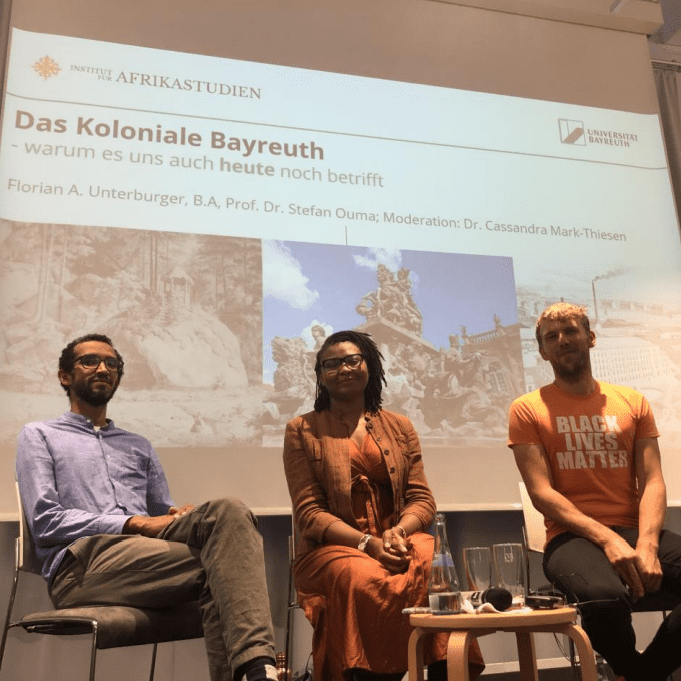
​July, 2023: The Colonial Bayreuth - Why It Still Concerns Us Today Hide
Bayreuther Stadtgespräche-Diskussionsrunde

Speakers: Dr. Cassandra Mark-Thiesen (African and Global Historian, University of Bayreuth), Prof. Dr. Stefan Ouma (Economic Geographer, University of Bayreuth), Florian André Unterburger (Historian B.A. and Initiator of the Industrial Museum Bayreuth (IMB) e.V.)

Bayreuth's industrial prosperity is deeply rooted in colonial economic activities - without cotton, sugarcane, or tobacco, the local industrialization would have taken a completely different course. However, instead of tracing the traces of these raw materials and critically examining the circumstances of their production, racist and colonial language and imagery persist in the public sphere. Through this simultaneous omission and devaluation of Black people, the colonial legacy of the city continues to exert its influence to this day. In this public discussion, Cassandra Mark-Thiesen, Stefan Ouma, and Florian André Unterburger embark on a search for traces, aiming to initiate an interdisciplinary exploration and examination of Colonial Bayreuth.
Link to the poster


Webmaster: IAS-Coordinator

Facebook Youtube-Kanal Instagram LinkedIn UBT-A Contact